Sound Forge ™ Pro provides efficient and reliable work for editors and sound directors, taking full account of all aspects of sound editing and mastering. Whether in the studio or in the field, it is extremely useful software for media professionals who need to create and edit audio files quickly and accurately.
MAGIX SOUND FORGE Audio Cleaning Lab Latest Free Download 'I consider SOUND FORGE and Samplitude to be the ultimate couple for my music. I do the hard work in Samplitude, and finalise with SOUND FORGE Pro, which itself has greatly improved from its previous versions, allowing to work with multichannel audio, ARA2, and improved VST plug-in integration.' Every time I add a new VST Sound Forge wants to rescan all plugs on startup. No biggie except about every other time it gets hung up on any one of several Native Instruments plugs and just keeps rescanning the same three or four plugs until I kill it. I've gone in and told SF to not use.
With new precision event-based editing capabilities including integrated disc-at-once CD burners, professional noise reduction and time-stretching of the original timeline, Sound Forge Pro is a complete editing program that contains everything you need for professional sound recording and mastering. , sound design, restoration and CD creation according to the Red Book standard.
64-bit version: allows you to shape audio in an infinite variety of ways. 64-bit architecture harnesses the full power of your computer to meet even the most demanding requirements, leveraging the ability to expand RAM to the extent that your motherboard can support. This will help reduce latency issues when working on large projects.
VST3 Support: The program includes full support for VST3 effects of all high performance plugins.
POW-r Dithering Algorithms: is a set of three dithering algorithms. Each is optimized for simple recordings such as spoken word, recordings with limited dynamic range, such as rock music, and recordings with high dynamic range, such as orchestral music. Just choose the type of noise reduction that adds the least amount of color to the sound.
Support for additional formats (DSD): You can now import and export Direct Stream Digital (DSD) audio files. This allows you to enter the high quality audio market as this format is compatible with equipment such as the Tascam DA-3000 or TEAC UD-501. At 352.8 kHz / 24-bit PCM, the highest possible quality is guaranteed. Record and mix in PCM format and export to DSD format for Super Audio CD (SACD) mastering and high quality archiving.
The supremely ultra-precise SOUND FORGE Pro delivers the best quality audio recording and playback. You can simultaneously record up to 32 channels in high resolution, 64-bit quality and sampling rates up to 384 kHz. Therefore, rest assured that it is the ideal audio processing tool for a wide range of professional tasks: from mastering CDs to processing soundtracks to high-quality video.
New interface
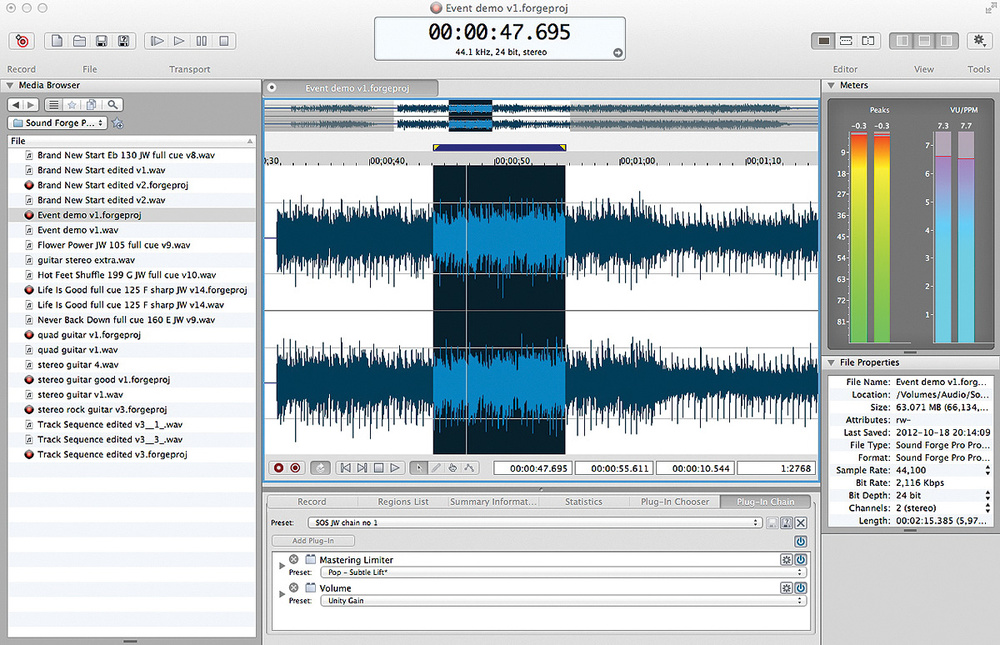
For a better user experience, the SOUND FORGE Pro 13 interface is adjustable in four hues. Together with the redesigned icons and docking features, your workflow will take center stage.
NEW! VST Engine
The VST2 / 3 engine in SOUND FORGE Pro has been redeveloped further and is impressive in terms of its enhanced stability and speed when scanning and using plug-ins. In addition, the dialog between VST host and the effect plug-ins is now more efficient – with a faster, more precise workflow as a result.
New visualizations
Gather industry-standard visual feedback with the Peak Meter V2 or deep dive into waveform visualizations with the new oscilloscope.
New mastering effects
SOUND FORGE Pro 13 Suite features brand new delay & mastering effects (2-Point Compressor, Limiter, Expander, Compressor, Gate, VolumeFormer, Delay, Chorus, and Flanger) from the new coreFX Suite.
Instant Action
The new Instant Action window allows for split-second access to commonly used tasks. Get a clearer overview of all essential tools and functions. Areas of the program are clearly divided into Workspace Actions, Effects, Mastering, Export and Import Action, allowing for faster orientation and faster end results.
Windows context menu
Perform basic tasks such as converting or normalizing an audio file by right-clicking directly within the Windows context menu. This is now integrated in the Windows context menu, so you don’t even have to open the program to search for functions.
The new WaveColor
The innovative WaveColor tool enables you to colorize a waveform to make it more visible. Identify unwanted frequencies at a glance. With WaveColor, pitches and sound characteristics in your audio files are assigned different colors and saturation levels to make it easy to see what’s happening in the waveform.
New spectroscope
The new spectroscope is powered by the latest FFT technology and offers precise and detailed real-time frequency analysis. It offers active support as part of your audio editing workflow as well as the mastering process.
NEW! ARA2 support
The new ARA2 interface extension allows for more comprehensive information exchange between SOUND FORGE Pro and its plug-ins. Audio data is transferred faster to plug-ins, allowing for more efficient editing in realtime. From simultaneous editing of several tracks to seamless clip borders – ARA2 offers even more editing options.
Bring your audio up to professional spec before you burn that CD
by Rich the Tweak
OK class, your assignment for today is to put your 2 favorite commercial CDs in the CD player along with your CD you have made. Now take out a sheet of paper and write down the differences you hear between a polished commercial track and yours. If you are a beginner to the craft this is an easy assignment--there may be so many differences that you might not know where to start. For the advanced home producer/engineer you may already be very close. Now it's time to take it the final mile. Here's my list of issues with my audio (see I get to participate in this too).
| My list of issues: | Issues Novices Typically Face |
| Excessive bass at times, some inconsistency Not as smooth as commercial Mixes, especially in the mid range Not as punchy as commercial music Inconsistent imaging between different songs and sometimes in the same song Doesn't sound as good in the car as it does on studio monitors Vocals not as clear or sweet Mid range is harsher, more grainy Image is neither as wide or as 3 dimensional as some commercial mixes | Not as loud as commercial tracks even though it was compressed Track is noisy, harsh, hurts ears at high volumes Weak Bass, weak kick, disappearing kick, or it's too boomy and it drowns the rest out. Drums can't drive the track unless they are too loud One dimensional, flat sound, even though instruments were panned Everything runs together into a mushy, indistinct, sound Unintelligible, buried vocals Sounds 'way different' on the car, boomy bass, no presence, muffled Balance between channels if off and it changes throughout the song |
The reason why I made you do this little exercise was to give you a sense of what corrective actions you might take to get your tracks up to commercial speed. The correct use of audio plugins provides for solutions, at least partially, to all of the issues above. Naturally, if your other recording gear is not up to speed, or if your tracks were not recorded well in the first place you will have some trouble. The best plugins in the world will not fix a harsh sounding digital/analog converter (though they will still dramatically improve the output). And of course, bad material, off key vocals and poor performance is a show-stopper no matter what you do. Don't think just because a pro studio has great gear that they don't have to deal with the same problems we've listed above. They do! The difference is they have tools to fix them and know how to fix them. Every studio deals with off key vocals, 60hz hum, trouble getting the snare to sit right, getting the bass so it sounds good on a boom box as well as a high end audiophile system. You might be surprised to discover (given you have decent mics and preamps and a nice audio interface) that their source material is not that much better than yours. They just know what and when to tweak, and when not to tweak. Lets cover the basics for the Newbies.
What is a plugin? A plugin is a small computer program which fits into the virtual mixer in your sequencer. Plugins typically model themselves after hardware rack units used in professional studios. For example there are plugins for effects boxes, such as reverbs and delays, effects pedals, like guitar distortion, flange and chorus, and for mixing and mastering processors such as compressors, limiters, exciters, sub bass enhancers, stereo imagers and many more. In the virtual studio of the sequencer, the plugin effectively replaces these hardware boxes with their software equivalents. |
All About Plugins
The audio goes 'through' the plugin depends on where they are placed in your mixer. There are basically 3 types of plugins. 1. Track based 2. Bus based. 3. Mix based
A Track based pluginis an insert that affects only that track. The plugin goes on the audio channel itself, so all audio leaving that channel is effected. Plugins that should be used on every track individually are compressors (and on tracks that must be as loud as possible, a limiter). If necessary, you may want to add a noise gate, EQ, and delay, chorusing or flanging to a track. Vocal tracks may benefit from exciters, de-essers and tuning plugins. Guitars should have their processing at the track level.
A Bus based pluginis one that you want to apply to more than one track, but not the entire mix. These use the sends on your virtual mixer. You create a bus and use the send on each channel to route audio to it. The typical plugins for busses are reverbs. You may need more than one. Having different tracks go through the same reverb is tried and true studio technique to give the impression the performers are actually playing in the same room. It's also critical for setting the front/back depth perspective of your soundstage. For creative tweaking, there's no end to the things you can do with sends and returns in the virtual environment of the sequencer. But as you get started, just use standard reverb and delay as your bus based plugins.
A Mastering plugin goes as an insert to your master out--its the last step in the chain before the final print and all of the audio goes through it. These plugins are the ones that are most critical to the 'overall sound' of the final product. And it is here where we can solve many of the problems listed in our above exercise.
Important Tip: If you feel like you have no idea where to put all these plugins, use the above be your guide. Now think. Do you want the effect to affect only the one track? Then use the plugin as an insert. Do you want many tracks to go through the same effect? Then create a bus-based plugin. Generally, we leave mastering plugins alone till after we finish the stereo mix, but these can come in handy on groups of tracks. They are also good for one-offs to cd and mp3 while the work is in progress. |
Plugin formats. There are several plugin formats which include VST, DirectX, Core Audio, RTAS, TDM, AudioSuite, and MAS. . First, you should note which format plugins your sequencer supports. Cubase, for example, supports VST plugins. Cakewalk and Sonar rely on Direct X or VST. (Note that it seems to me Direct X is gradually being phased out). Logic PC supports both VST and Direct X. Logic Mac only supports Audio Units. Digital Performer supports MAS. RTAS, TDM and Audiosuite are formats used by various Digidesign products. Sometimes you can, with the addition of a 'wrapper' plugin, use other formats in your sequencer.
A cool thing about plugins is that they work in all compatible audio applications you have on your system. For example, if you get a quality DX plugin for Sonar, you can also use it in ACID, SoundForge, Vegas. You can use the VST plugins that come with Cubase in other VST applications like Wavelab and even in Logic PC. You simply copy the plugin folder called 'VstPlugins' from your Cubase directory to your Logic directory. Yet regardless of the format of the plugin, they are all used in the same ways, on tracks, busses, and master outs.
Free plugins Free plugins should be used with caution. They may crash your sequencer or make it unstable. I personally will not use them. It's just not worth it to add a questionable device to an application that has to work in real time.
How To Get Sound Forge To Recognize My Vst Plugins Torrent
The best plugins The best plugins are not cheap. They don't sound cheap either. One secret the people in large expensive studios have over you is they too use plugins, sometimes the same ones you already have in your sequencer. Yet you will also find the top plugins in their arsenal. The quality of a high end plugin can indeed match the quality of its hardware counterpart.
Plugin Bundles
Antares
How To Get Sound Forge To Recognize My Vst Plugins Free
You know the sound. Everyone's doing it. Vocals are repitched and flattened to musical notes. Though Antares is not the only software plugin maker that can get this effect, it often gets credit for it. There is also Celemony's Melodyne Plugin and Waves Tune Native plugin. Before you spring though, make sure you don't already have one of these. Logic has a pretty capable pitch correction tool, and Cubase just added a new feature to Cubase 5 (full version) called VariPitch.
Yet the Antares AutoTune Vocal Studio looks like their most ambitious bundle yet. It includes Auto Tune Evo and Avox Evo, that includes the Vocal Toolkit which now includes Harmony Engine Evo. Whew! You'll need to have an iLok for authorizartion.
Auto-Tune Vocal Studio Native and Auto-Tune Vocal Studio TDM combine Auto-Tune Evo, the worldwide standard in professional pitch correction, with AVOX Evo, the latest generation of the Antares Vocal Toolkit (now including Harmony Engine Evo). Together, they provide a comprehensive suite of tools for producing world-class vocal tracks.
There are two major plugin bundle makers. Universal Audio and Waves. Both a famous in the studio world and make a complete set of plugin audio processors that would take a roomful of expensive gear. There is a disadvantage to buying bundles. Sometimes you buy plugins you will never use, because they come in the bundle. Both companies let you buy smaller bundles then upgrade your set by adding individual plugins later, but this method quickly becomes more expensive. I have both the Waves Platinum Bundle and the equivalent of the UAD Ultra Pak with a few extras added in. I used the Waves bundle when making my sample cd roms and they were extremely helpful tweaking my samples in Sound Forge. I have the UAD bundle installed on my Mac and I use them in every production, even though I have all the Logic plugins and many Native Instruments processors also in my Mac's arsenal. Overkill? Yes. You don't need as many as I have.
Universal Audio
Universal Audio is a name that goes way back into audio history. Two legendary products are UREI/Universal Audio 1176 Compressor Limiter and the revered LA-2A Leveling Amplifier. The sons of the late Bill Putman, who designed the 1176 and LA-2a, have rekindled the company. You can read more about the story. Working from their father's original schematics, they built a hardware re-issue of these classic compressors and then took it one step further. The UAD-1 plugins require a hardware card that fits in your computer. These come in PCI, PCIe formats. Make sure you get the right one!
Some of Universal audio's plugins are computer models of actual hardware audio processors. That is what makes them so valued. Many people say they have a hard time telling the difference between the plugin and the actual hardware. Units like the Pultec EQ, Fairchild, Roland Space Echo actually exist in the real world.
Universal Audio UAD2 Solo Flexi DSP Card (Macintosh and Windows)
How much power do you need? Well, for me the solo card is just fine as it is 2.5 times the power of my previous UAD-1 card. I also use a lot of Logic plugins. But if you have big mixes and want to use UAD exclusively on every track you are going to need more than the solo. Be careful to buy the right UAD pak for your computer. For example, the Mac Pro has to use a set with a PCIe card; most PCs can use a PCI card. | Hardware Supported PluginsHardware supported plugins require the hardware be present to run. They also take strain off the CPU by doing the processing in hardware, hence there is less of a drain on the computer for processing audio in real time. Also the hardware prevents piracy, so the developer is able to get a return for their efforts. The UAD bundles only get you started. Once you get a card and the basic plugins installed you'll open an account at UA where you can buy more plugins ala carte or can take advantage of their special offers which change every month or so. Its a great idea to go there ahead of time to see how much the plugins you think you want will cost to get a full idea of what you are getting in to. Some of my favorite UAD plugins: Pultec Fairchild Precision Limiter Precision EQ |
Waves Musicians II Native Plug-In Bundle (Macintosh and Windows) Waves Native Silver Bundle (Windows and Macintosh) Waves Native Gold Bundle (Windows and Macintosh) Waves Masters Bundle Native Version (Windows and Macintosh) Waves Native Platinum Bundle (Macintosh and Windows) Waves Native JJP Software Plugin Bundle Waves Native API Collection Plugin Bundle (Macintosh and Windows) Waves SSL 4000 Collection Native Waves Tune Native Pitch Correction Software (Macintosh and Windows) | Like the UAD, Waves has its bundles all at different price points. But with Waves, the larger bundles include the smaller bundles. For example, the Mercury bundle includes the Platinum bundle, which includes the Masters, Gold and Silver Bundles. With Waves, as with UAD, you can buy more 'add on' bundles or upgrades at their online store. A good way to start a Waves collection is with the Silver or Gold bundle. Upgrade to Platinum later if you like them. More recently Waves has added some specialty plugins like the JJP bundle or the pitch correction plugin. As with UA's stuff, you want to research before you buy. Make sure you read the terms of the Waves Update Plan on their site. Waves plugins require authorization via iLok, which allows you to use your plugins on a different computer. This may be advantageous over the UAD card based system, which is harder to move. Some of my favorite Waves Plugins: Linear Phase multiband Renaissance Channel and L3 Ultrmaximizer Wave's PuidChild 670 (aka Fairchild) |
Waves
My older review of Waves Platinum (before I got the UAD)
There are probably more studios relying on the Waves L1 Ultra Maximizer and C4 Multiband than they care to admit. The difference these can make on ones music is outstanding. Want to hear the difference it can make? Download the demo from Waves. It's fully functional for 14 days so you can actually use it to master some songs courtesy of Waves. If you are like me, the question might not be if you can afford it, it might be can you afford not to have it
It took me a long time to warm up to the Waves products for a couple of reasons. They are expensive, and every time I'd look at the back of the box I'd see plugins I already had. Lessee, I have my multiband compressor, my reverb, my gate, my multi-tap :) After all, it all sounds the same, Right? Wrong! It took me less than 10 seconds of running my audio through a TrueVerb, a Renaissance EQ or a Ultra Maximizer to become a total evangelical convert. Your talking to a guy who has all the sonic foundry plugins, all the Logic plugins, and many of the Cakewalk and Steinberg plugs. What sets the waves plugins apart from the rest is not only it's stunning graphics and outstanding ease of use, but their unbelievable audio quality. The audio comes out of the oven warm, supple and professionally smooth. You really have to hear it.
| Free Plugins | |
|
My mixes are louder, clearer, with better bass, better transients. I've spent nearly a week just getting acquainted, bouncing old songs from DAT into the computer and then processing them. In about two minutes I can get dramatic improvements, just by chaining the 10 band parametric, if needed the Renaissance Bass, the C4 multiband, sometimes the stereo imager, and finally the L1 Ultra Maximizer. If you had a good mix to begin with, you'll find it easy to make it outstanding. Even if you had a just an old recording from cassette, you'll be surprised to find dynamics and nuances that were deeply buried in the original. The 10 band is so precise you can cut away damaged frequencies surgically, something that my hardware 31 band is supposed to do, but can't, not like this! The L1 Ultramaximer works so well with Logic that the peak meters match exactly. That is, if the L1 says it will limit at -.01 db that's exactly where Logic's meter pegs, ditto for bouncing to DAT. The result is increased resolution you can hear. Better tracking, better bouncing and a better mixdown.
Each plugin comes with a .pdf and paper manual so you can learn how the experts use these. I'm also getting awesome results editing samples in SoundForge with them, discovering new ways to polish sounds that eclipses differences between my studio and the big studios downtown. One cool thing is the 10 band parametric. Not only can you EQ your sample exactly the way you like, you can create a different EQ for the left and right side, and level each side so they peak exactly at 0db. And you can give your samples as much high end as you want, and surprisingly, the results are not harsh or strident. This allows one to make the perfect sample. It's good magic.
iZotope's Ozone Mastering System
How To Get Sound Forge To Recognize My Vst Plugins Download
A less expensive, yet complete software mastering system is iZotope's Ozone. Ozone comes in the form of a direct x plugin. But it's much more than a single plugin, it's like getting an entire mastering suite in one single interface. You get a paragraghic equalizer which has an excellent real time spectrum analyzer; a mastering reverb; multiband compressor; multiband harmonic exciter; multiband stereo imager and finally, a loudness maximizer.
You can chain these up however you like. The bands are moveable, just like on the expensive hardware multibands. One advantage of having all these in one plugin is you can bypass all these functions at once, or quickly bypass only certain ones. This saves time (and wear and tear on your ears) and lets you make the instant comparisons you need to do when mastering. You'll have a hard time finding plugins that can do multiband imaging and exciting anywhere (you won't find them in the Waves set, for example) and the way these work in concert with the multiband compressors is awesome. One cool thing I was able to do with the imager was to widen the midrange yet leave the bass alone where it was distinct, front and center--try that with your garden variety stereo imager. Also the mastering reverb is truly a godsend, just a little touch goes a long way. I like how you can easily set it to a narrow bandwidth so you get depth exactly where you want it and not where you don't want it. The Loudness Maximizer gives predictable results every time. It has a 'brickwall' limiter much like the Waves L1 that lets you jam audio into every nook and cranny of the audio bandwidth if you desire. There's also a 'soft limiting' option that is perfect for when you want to exploit the full dynamic range of the audio bandwidth, with quiet sections as well as loud bombasts.
I've tried Ozone with Logic 5 (PC) as well as Logic 7 (Mac) and Vegas with excellent, glitch-free results. I also found the spectrum display to be great at helping isolate system noise coming into my audio interface--stuff you can't hear unless you crank the gain. Mastering is an art that takes practice, but with Ozone, it's easy to get experience under your belt fast. Check it out for yourself and download the demo. Tweak gives Ozone two strong thumbs up. Get more info on Ozone.
IK Multimedia
IK Multimedia has long been the provider on the less expensive side of the plugin makers.
| IK Multimedia Classik Studio Reverb and T-RackS Bundle |
| IK Multimedia's knows that nothing matters most than the final mix. The Classik Studio Reverb and T-RackS plug-ins are world-renowed effects that can help you meet the toughest mixes in the face and wallop them. Bundling them together both complements your studio and your budget. Get your bundle today! |
Cleansers
Cleansers? Yep. Audio can get dirty. Hum from unbalanced lines, ambient noise picked up from mics, hiss from old tapes, scratches on vinyl, and clicks and pops, radio frequency interference from poorly configured soundcards can all conspire to ruin your beautiful sounding tracks. Naturally, the real solution is never to incur these maladies in the first place, but often we don't have that option when we are working for clients, or when grandma wants your second cousin's 4th grade acapella cleaned up. As usual you can pay a little or pay a lot for restoration software, and there is no guarantee they will be able to fix everything. But they will help.
iZotope RX is the most complete audio restoration product on the market. This standalone application combats a range of audio problems via innovative restoration modules, detailed analysis tools and time-saving workflow features. Ideal for archiving, recording, mastering, broadcasting, podcasting, video production and forensics.
Bias makes a PC/Mac entry level plugin called Sound Soap. I have that one, and it is good if used in moderation. Bias also makes a full-scale version called SoundSoap pro.
Leave it to Waves to chart the high end here with the Waves Native Restoration Bundle.
For those who work on Sound Forge you might want to check out their Noise Reduction 2 plugin.
All of the 'cleansers' are going to take practice to perfect. Its very easy to mess up your files so you want to have backups before you begin.
Convolution Reverbs
One of the more recent entries into the Plugin Scene are convolutuon reverbs. This differ from typical reverb plugins as they use mathematical models of characteristics of different spaces to create their effect. The result is a much more realistic reverberant output that can exceed the quality one can achieve in the best hardware reverb boxes. The drawback to convolution reverbs is the immense hit on the CPU. Even today's fastest computers can't do too many of these in real time.
One of the first was Sony's Acoustic Mirror, which is now bundled in Sound Forge. Emagic then launched Space Designer and eventually bundled it into Apple's Logic. Waves released the IR1 Convolution reverb and recently the IRL Convolution Reverb ('L' is for 'light')
More cool stuff
How To Get Sound Forge To Recognize My Vst Plugins Youtube
Izotope Spectron Spectral FX Processing Plug-In
Spectron is the newest must-have tool for sound designers. It offers limitless spectral processing housed inside a powerful interface which lets the user control entire groups of frequency bands with virtually limitless options for sweeping and triggering. By chaining effects including morphing, panning, delay, and filtering. It's almost impossible not to find a unique sound with Spectron.
Wrapping Up (sic) for now.. Of course there's tons of other plugins available. I don't have them all, so there is no way this can be considered a comprehensive review. This article just touches on one that I know and like. The point is that plugins can dramatically alter your sound for the better and if you haven't explored this aspect of your digital audio sequencer you are truly missing out. The Holy Grail of Audio is not as far from your studio as you might think. With quality plugins like Waves, you can jump to the top of the class and deliver some outstanding audio.
Best of Luck in your studio enterprise,
Rich the Tweak
Go to the Next Class
Go to the Previous Class
| Want to talk about software plugins? Benefit from others experiences! Join the discussion at Studio-Central! |
Cool Quote: Genius is present in every age, but the men carrying it within them remain benumbed unless extraordinary events occur to heat up and melt the mass so that it flows forth. Diderot (1713 - 1784) |